

Maintenance Reality Index™ (MRI)
Two boats with 1,000 engine hours do not have the same maintenance reality.
Traditional maintenance asks: “How many hours since the last service?”
SignalNav asks a better question: “How harsh has this vessel’s life actually been?”
MRI is a dynamic score that reflects how aggressively a vessel’s systems are aging — compared to standard assumptions. It translates real-world usage and environment into a clear, defensible maintenance signal.
SignalNav asks a better question: “How harsh has this vessel’s life actually been?”
MRI is a dynamic score that reflects how aggressively a vessel’s systems are aging — compared to standard assumptions. It translates real-world usage and environment into a clear, defensible maintenance signal.
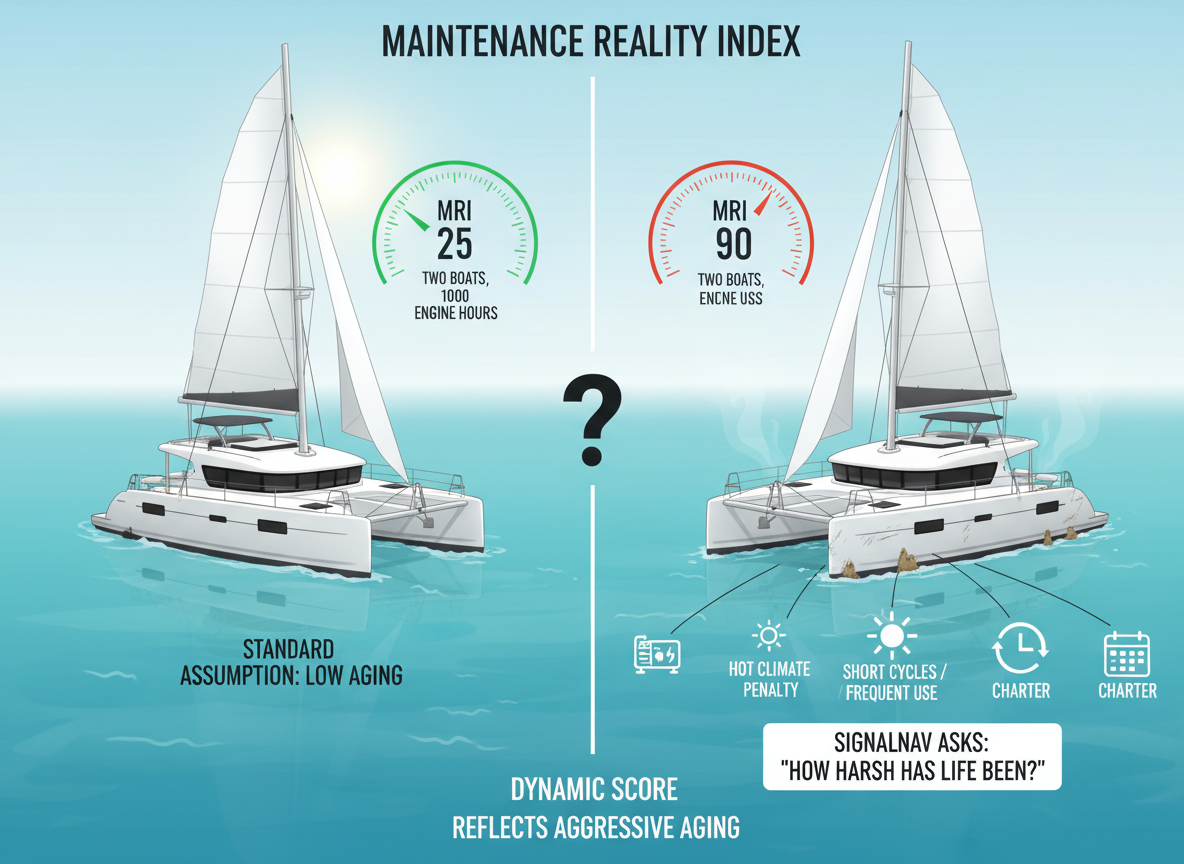
What MRI does
Adjust maintenance expectations based on reality — not averages.
MRI continuously evaluates how the vessel is operated and the conditions it’s exposed to.
The output is a single index that helps teams align on service timing and risk — across technicians,
operations, management, and owners.
- Adjusted service intervals based on real usage intensity
- Risk-based maintenance planning (what to service first)
- Transparent justification for owners (why now)
- Predictable budgeting and fewer surprises
MRI v1 inputs (plain English)
MRI v1 combines multiple real-world factors — no single metric tells the whole story.
1) Runtime intensity
Short, repeated runs create more wear than long, steady operation. Frequent starts, cold running,
and stop–start cycles accelerate degradation.
2) Generator dependency
Heavy generator use often reflects anchoring behavior, hotel-load reliance, or poor shore power access —
increasing mechanical and thermal stress.
3) Load and usage patterns
Sustained high-load operation and erratic throttle/load patterns increase wear compared to stable operation
in optimal ranges.
4) Environmental exposure
Heat, humidity, and salt accelerate aging across mechanical and electrical systems. Hot climates and corrosive
environments raise maintenance risk and shorten effective intervals.
5) Operational context
Charter vessels typically live a harder life than privately used vessels. Usage frequency, turnarounds,
and daily operational intensity matter.
6) Idle vs active stress
Idle systems still degrade, but loaded runtime degrades faster. Extended idling under electrical load and
low-speed running can create its own wear signatures.
Why this matters
Because “hours” don’t equal “wear”.
MRI helps teams move from reactive maintenance to controlled asset health — with a clear explanation that holds up
in operational reviews and owner conversations.